The Testaments: A Queer Reading of Rebecka Grove


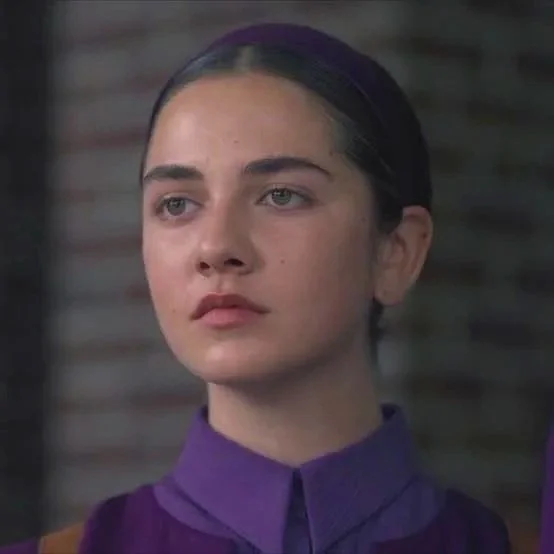
I watched the Hulu adaptation of Margaret Atwood’s The Testaments (the sequel to The Handmaid’s Tale) before reading the book, and I was absolutely devastated and moved by Mattea Conforti’s performance as Rebecka Grove. I ran to the book to experience more in-depth queer heartache, but clearly, after reading the book, it seems the show took its own liberties with Becka’s queer storyline. I do think Becka was meant to have queer subtext in Atwood’s original The Testaments, but it was much more of a read-between-the-lines conclusion that the reader might come to. The show makes it a much larger, much more obvious storyline. The longing of one-sided queer love is always painful, but it is even more devastating within such an oppressive society, where the consequences of being a “gender traitor” are not only shame and societal outcasting, but death. This analysis compares how Becka’s queerness is portrayed in the book versus the show, and takes a deeper dive into the powerful moments the show added to her story.
Book – In the book, Becka is much less obviously queer than she is in the show. It would actually take quite a dissection of subtext and perceptivity to get there. In fact, the book even portrays Becka and Agnes more as sisters. One could argue that since none of the book is from Becka’s perspective, and it is only Agnes’s account of their relationship, we are unable to see the true nature of Becka’s feelings for Agnes. Whereas in the show, there are multiple scenes from Becka’s story where Agnes is not there, and even in the scenes where Agnes is present, the longing in Becka’s eyes goes a long way, which is much harder to do in a book, especially if Agnes, who is telling the story, does not see it for what it is.
In the show, we are able to see Becka’s private conversations with Jade/Daisy/Nicole, as well as many individual moments with Becka and her family. Also notably, in the book, Becka is sexually assaulted by her father, whereas in the show she is not. Therefore, her aversion to men is easily chalked up to that; whereas in the show, it is not. Because of this, I can see the argument that Becka is queer in the book, but there is no way of really knowing from what we got other than inference and reading from a queer lens. Though, Becka and Agnes sharing a room as unmarried aunts for the majority of their lives is definitely queer coded. I appreciate the creative liberties the show took to represent the underrepresented, but all credit goes to Margaret Atwood for creating an ambiguous, powerful character at the core of Becka, who leaves the reader thinking.
Show – In the show, Becka is immediately shown to be Agnes’s best friend since childhood, strengthening their connection and adding to the heartache of the longing, because it is understood that the longing must have existed before Becka would fully understand what it was. She is immediately shown to be a moth drawn to the flame that is Agnes. As they get older, and Becka begins to understand more fully what her love for Agnes is, you can see it spilling from her eyes in every scene. The internal struggle is so well portrayed. While Agnes is going about her role and duty to Gilead, preparing to be married and creating the rest of her life, Becka is preparing for her life to be over.
As most queer longing goes, Becka seems to have had a subconscious inkling of hope that their connection meant more to Agnes deep down, hoping she just had not realized it yet. Becka soon realizes, specifically in the bathroom scene, that Agnes does not want what she wants, which propels her into a depressive, lonely state. It is not clear whether Agnes perhaps has these feelings deep down, or if Becka has been idealizing their connection forever. Either way, it is heart-wrenching, and all the hope Becka had resting within Agnes is crushed. Becka marches toward her fate, not because she wants to, but because there are simply no other options. In this society, it is quite literally follow the status quo or die.
When Agnes tells Becka she is in love with Garth, Becka lies and says she has never been in love before, but then tells Agnes she is lucky to have felt that love, even once, because most people do not get to.
When Agnes is dancing with Garth, she narrates, “This is how it is supposed to feel.” Before this, in the hidden female space of Agnes’s bedroom, Becka teaches Agnes how to dance, and the viewer can see in Becka’s eyes the extreme grief because she finally realizes, this is how it is supposed to feel, yet this will probably be the only time she is allowed to feel it. I think this conversation also works in unison with one of the last scenes of season one.
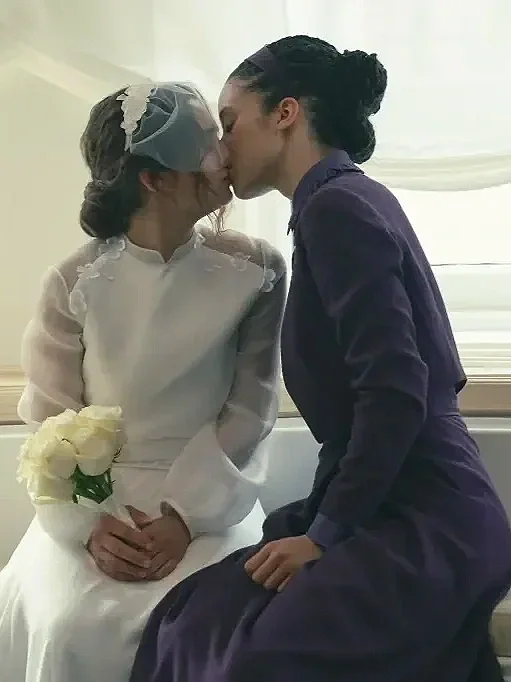
When Becka is drugged and preparing to walk down the aisle, she kisses Agnes gently on the lips, and Agnes lets her do it. This scene is initially confusing, as the viewer is not led to believe Agnes loves Becka the way Becka loves her, so why would she allow it? This scene takes place after Becka kills her father “for Agnes.” When Agnes confides in Becka about what Dr. Grove had done to her, Becka feels the need to murder her father as a type of divine retribution. This action proves that Becka does not truly feel connected to anyone but Agnes, not even her own parents, because Agnes is the only person with whom she has a true connection and the only one who ignites her true self. She has no problem sacrificing her father for her love of Agnes. This goes back to perhaps the most explicit queer line in the book, in which Becka says, “I have never loved anyone but you.”
Though I usually do not like the trope of the “crazy queer person,” I genuinely do not see another storyline for a queer person in Gilead, as the oppression can only lead to a psychotic break, as we see with Becka. Rather than cheapening the queer experience, in this instance I think it adds to the viewer’s understanding of all that Becka is bottling inside. When things are bottled up, they eventually explode, as Becka does on her father, who to her represents Gilead and the dishonorable actions of men as a whole.
It is unclear whether or not Becka thinks murdering her father will endear her to Agnes, or if she is simply going through a psychotic break. When Becka comes into Agnes’s room in the middle of the night covered in blood, Agnes has a moment of recognition, and then mercifully and gently accepts her. I believe Agnes realizes in this moment how Becka really feels about her, which leads us back to the kiss. It seems that both Becka and Agnes know this is the last moment Becka will be free, in a way. Becka feels she has nothing to lose and is high; therefore, she kisses Agnes, and Agnes allows it as a mercy to Becka: a way of telling her “I accept you for who you are, and recognize the type of love you have for me.”
It goes back to the idea that you are lucky to have loved someone, even if only once. They both seem to understand the kiss is a one-time thing, and Agnes allows Becka to have it: real love and a real kiss, just once, before she is married away forever.
Overall, whether explicit or not, Margaret Atwood creates a touching narrative of trapped and oppressed femininity, showing a potent erosion of self through the queer-coded Becka. While the show takes its own creative liberties by rearranging Becka’s plot, the intentions seem to stay intact with Atwood’s original narrative. Regardless, Becka’s story leaves the reader thinking, and grieving, long after both the book and the show end.
